Poland’s Consumer Authority Fines State-Owned Banks Over Credit Holiday Violations
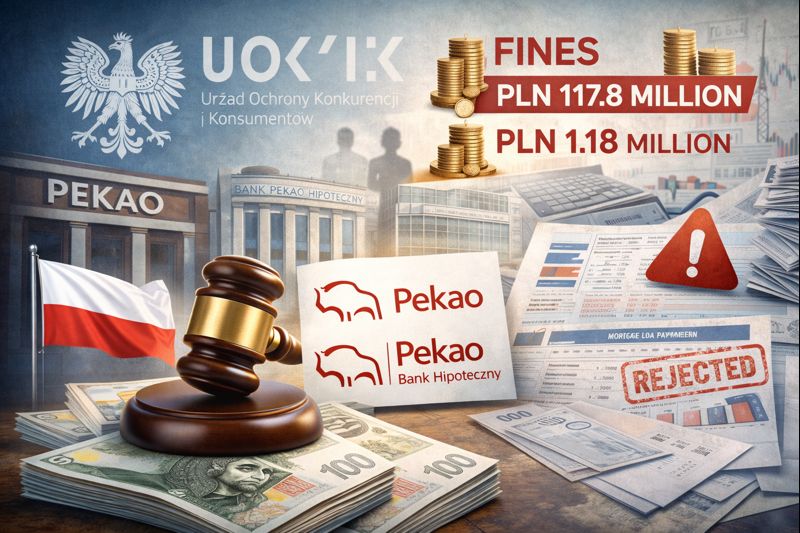
Poland’s Office of Competition and Consumer Protection (UOKiK) has imposed significant financial penalties on two state-owned banks, Pekao and Pekao Bank Hipoteczny, for improperly applying provisions of the Credit Holiday Act. The law, which was in force from August 2022 until the end of last year, was designed to provide temporary relief to borrowers struggling with mortgage repayments. According to UOKiK, the banks’ practices resulted in less favorable conditions for consumers than those guaranteed by legislation.
The authority found that both institutions followed the same statutory procedure when handling applications for the suspension of loan installments. Problems arose mainly when borrowers submitted their requests in the final month of a given quarter. In such cases, the banks granted payment holidays only from the date the application was filed until the end of that month, rather than for the full month. Despite the shorter suspension period, however, the banks automatically extended the loan repayment schedules by an entire month.
UOKiK concluded that this mechanism may have increased the overall cost of loans, effectively placing an additional financial burden on consumers. The regulator argued that borrowers ended up repaying their loans for longer than justified by the actual duration of the payment suspension. UOKiK President Tomasz Chróstny stated that the practice was applied systematically and exposed customers to unnecessary expenses, undermining the protective purpose of the credit holiday regulations.
As a result of the findings, Bank Polska Kasa Opieki SA was fined PLN 117.8 million, while Pekao Bank Hipoteczny SA received a penalty of just over PLN 1.18 million. In addition to paying the fines, both banks have been ordered to inform affected customers about the violations identified by the authority.
The decision is not yet final, and the banks retain the right to challenge it in court. UOKiK emphasized that mortgage holidays were introduced as a support measure for borrowers, and any practices that dilute this protection constitute a breach of consumer rights.
Implications for Banking and Business
Developments in the Polish banking sector affect businesses operating in the country in several ways. Access to corporate banking services, credit availability, deposit rates, and payment infrastructure are all critical factors for companies — whether established Polish firms or foreign-owned entities entering the market.
For foreign entrepreneurs setting up operations in Poland, choosing the right banking partner is a strategic decision. Major Polish banks including mBank, ING Bank Śląski, Bank Millennium, PKO BP, and Santander Poland offer varying levels of service for international clients, including English-language online banking, multicurrency accounts, and dedicated relationship managers for corporate clients.
The Polish banking market is well-regulated by the KNF (Financial Supervision Authority) and participates in the EU deposit guarantee scheme (BFG — Bank Guarantee Fund), providing deposit protection up to EUR 100,000 per depositor per institution. This regulatory framework provides stability and confidence for businesses maintaining corporate funds in Polish banks.
If you are doing business in Poland or considering entering the Polish market, Zalewski Consulting can help. Learn more about our personal income tax advisory, or contact us for a free consultation.
About Zalewski Consulting
This article was prepared by the Zalewski Consulting editorial team. We provide professional company formation, tax advisory, bank account opening, and legal advisory services in Poland. Contact us for a free consultation.
More news from Poland
Related Reading from Our Archive
Consulting services
PZC provides all the services that foreign company or individual businessmen need when doing business in Poland. If you want to learn more about the given service click on it to see the detailed description.
Read more